
Learning Fruit Names in Arabic and English in Kindergarten
Teaching a second language to five-year-olds works best when words connect directly to real objects, colors, and hands-on activities. Fruit vocabulary provides an ideal link between home life, daily snack times, and early language development. When kindergarteners see a bright red apple on a page while hearing both “apple” and “tuffah,” their brains store the information across visual, tactile, and auditory pathways.
Printable worksheets and coloring pages bridge the gap between abstract foreign sounds and concrete visual ideas. Instead of memorizing flashcards through repetition alone, children develop fine motor skills while speaking vocabulary in both English and Arabic.
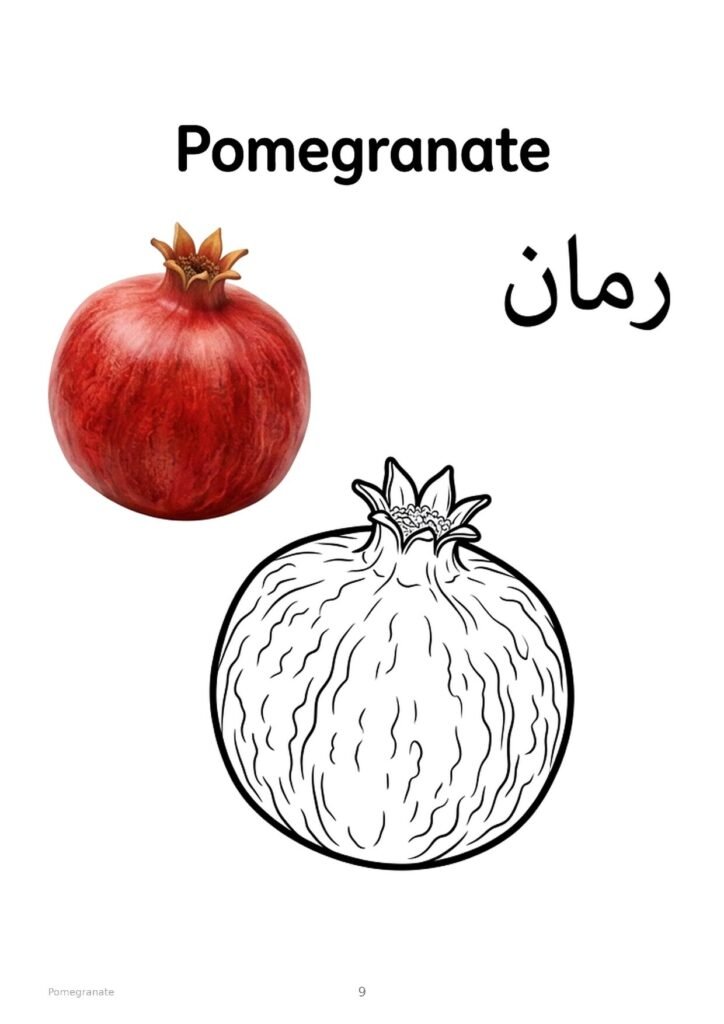
Core Fruit Vocabulary: English, Arabic, and Transliteration
When introducing Arabic fruit names to young English speakers, clear phonetic guides help parents and instructors pronounce each term with confidence. Here is a baseline list of eight common fruits to introduce during morning circle time or home learning sessions.
| English Name | Arabic Script | Transliteration | Pronunciation Guide |
|---|---|---|---|
| Apple | تفاح | Tuffah | Too-FAAH (emphasis on the double ‘f’) |
| Banana | موز | Mawz | MOWZ (rhymes with “cows” with a soft ‘z’) |
| Orange | برتقال | Burtuqal | Boor-too-QAAL (deep ‘q’ sound from the throat) |
| Dates | تمر | Tamr | TAM-r (short ‘a’ with a crisp rolling ‘r’) |
| Grapes | عنب | ‘Inab | EE-nab (starts with a soft throat tone) |
| Watermelon | بطيخ | Batteekh | Bat-TEEKH (ends with a raspy ‘kh’ sound) |
| Lemon | ليمون | Laymoon | Lay-MOON (very close to the English word) |
| Fig | تين | Teen | TEEN (sounds identical to the English word “teen”) |
Three Print-and-Play Learning Activities for KG
To keep kindergarteners engaged for 15 to 20 minutes, rotate through practical, tactile learning methods. Combining art with language repetition prevents fatigue and reinforces word association naturally.
1. Color, Trace, and Repeat
Hand your child a printable outline sheet featuring clear fruit illustrations alongside dual-language text labels. As they color a bunch of grapes purple or green, ask them to trace the Arabic script with a crayon while saying ‘Inab out loud. You can download our full Fruits Coloring Book to access clean, bold illustrations designed specifically for small hands.
2. The Real Fruit Snack Match-Up
Cut out printable cards featuring fruit drawings alongside their Arabic and English names. Prepare a small snack plate with real slices of apples, bananas, and dates. Ask the child to place the correct printable tag next to each piece of fruit before eating it. Connecting language learning to taste and smell cements vocabulary quickly.
3. Dual-Language Call and Response
Hold up a completed coloring page showing a single fruit item. Call out the English term (“Orange!”) and prompt your child to call back the matching Arabic word (“Burtuqal!”). Switch roles after two or three minutes so the child practices both listening and speaking in both languages.
Why Dual-Language Printables Support Early Literacy
Kindergarten is a crucial period for phonetic development and visual discrimination. Children who explore dual-language printables learn to recognize distinct writing systems early on. English reads from left to right, whereas Arabic reads from right to left. Pointing to words in both scripts teaches spatial orientation and directionality without causing cognitive stress.
“Pairing visual art with spoken repetition anchors second-language vocabulary into long-term memory far more effectively than traditional flashcard drills.”
Furthermore, printable activities give young children agency. Deciding which color to use for a watermelon slice or picking which fruit sheet to complete first builds independence and pride in their finished project.
Expanding Bilingual Vocabulary Across Themes
Once a child masters basic fruit names, expanding their bilingual vocabulary into other everyday topics keeps momentum going. Animals, nature, and sea creatures follow the same visual association principles. For instance, pairing fruit learning with our Animal Coloring Book allows you to teach animal names alongside what those animals eat, such as monkeys eating mawz.
You can also introduce plant life and color terms using the Flower Coloring Book. Maintaining a consistent printable format across different subjects gives young learners a familiar structure that boosts confidence.
Practical Guidelines for Parents and Educators
Working with kindergarten children requires short bursts of focused activity balanced with play. Follow these four practical guidelines to get the most out of your printable lessons:
- Keep lessons under 15 minutes: Young attention spans tire quickly. Short daily practice beats long weekly sessions.
- Praise effort over perfection: Arabic sounds like ‘Ayn or Kha take time for non-native speakers to master. Focus on willingness to try.
- Print on sturdy paper: Standard 20lb paper easily tears when wet with markers. Use 65lb cardstock for durability during coloring.
- Create a display space: Hang finished bilingual activity sheets on the fridge or classroom wall to provide daily visual review.
Download Free Printable Activities at Welcome Traders
At Welcome Traders, we offer a wide range of free digital resources and printable workbooks for parents, teachers, and home learning setups. You can download full coloring books, activity pages, and educational guides directly to your computer or tablet with no sign-ups, accounts, or limits. Visit our store today to grab your free downloads and start your next bilingual activity!
Free downloads for this topic
Further reading
- Learning more than one language. American Speech-Language-Hearing Association. Advice for families raising children with two or more languages.