
A Practical Framework for Home Islamic Learning
Teaching young children foundational Islamic knowledge at home does not require formal classroom training or hours of preparation each day. Consistently setting aside ten minutes after Asr prayer or before bedtime allows young learners to memorize essential phrases with ease and confidence.
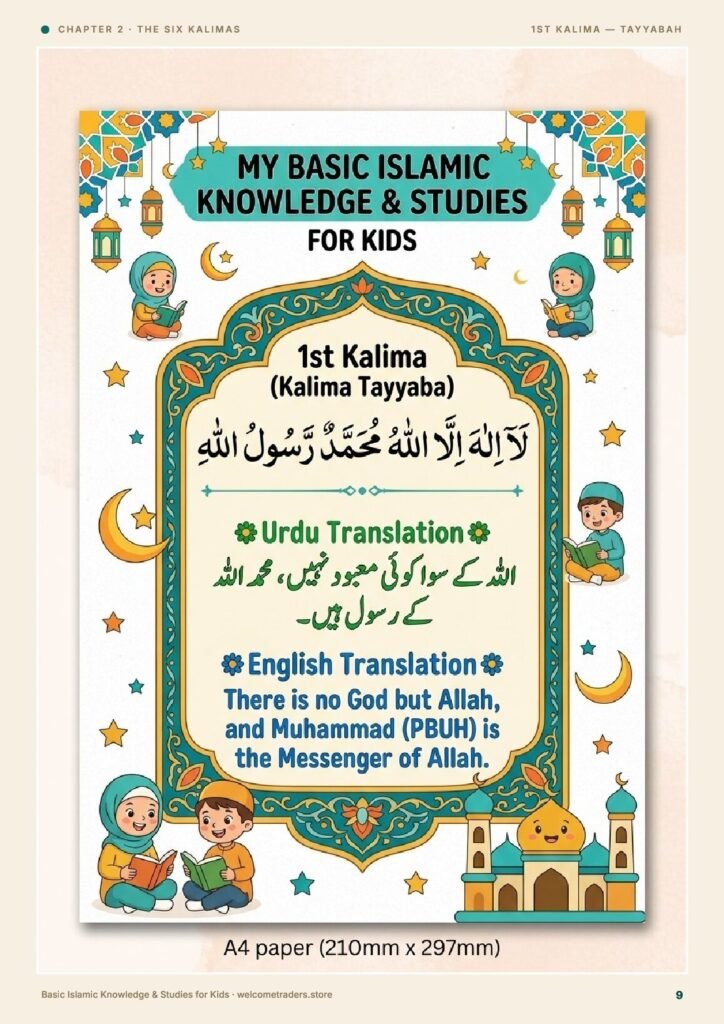
The Six Kalimas represent core beliefs, praise, and supplications in Islam. When teaching young children, breaking these texts down line by line helps prevent overwhelm. Paired with clear visual materials in Arabic, English, and Urdu, children retain both the pronunciation and the meaning far better than with rote vocal repetition alone.
Understanding the Six Kalimas
Before launching into a weekly schedule, it helps to understand how the Six Kalimas build upon one another in basic Islamic theology:
- First Kalima (Tayyibah): The declaration of faith and purity.
- Second Kalima (Shahadat): The testimony of belief in Allah and His Messenger.
- Third Kalima (Tamjeed): The expression of Allah’s glory and majesty.
- Fourth Kalima (Tauheed): The declaration of the absolute oneness of Allah.
- Fifth Kalima (Astaghfar): The prayer seeking forgiveness for shortcomings.
- Sixth Kalima (Rad-de-Kufar): The prayer for protection against disbelief and false beliefs.
Using a printed reference tool makes this process seamless. You can grab a structured copy through our Basic Islamic Knowledge & Studies for Kids guide, which includes step-by-step guides for the Kalimas, Wudu, daily Salah, and essential supplications.
The 6-Week Kalima Learning Roadmap
Introducing one new phrase at a time allows children to master pronunciation before moving forward. Here is a simple six-week structure designed for ages four through ten.
Week 1: First Kalima (Tayyibah) and Second Kalima (Shahadat)
Because most Muslim children hear the First Kalima frequently, Week 1 focuses on refining pronunciation. Read the Arabic text aloud slowly, focusing on clear articulation of each syllable.
Spend three days on Kalima Tayyibah, then transition to Kalima Shahadat for the remaining four days. Ensure your child understands the English or Urdu translation so the words carry personal meaning.
Week 2: Third Kalima (Tamjeed)
The Third Kalima is longer and introduces four major phrases of remembrance: SubhanAllah, Alhamdulillah, La ilaha illallah, and Allahu Akbar. Break this Kalima into three distinct segments.
Have your child recite segment one three times before adding segment two. By Friday, combine all three parts into a single fluid recitation.
Week 3: Fourth Kalima (Tauheed)
The Fourth Kalima focuses on the unity and authority of Allah. Because of its rhythmic cadence, children often pick up this phrase quickly once they master the opening lines.
Point to each line on your printed worksheet while reciting. Visual tracking strengthens memory connection between written text and spoken language.
Week 4: Fifth Kalima (Astaghfar)
Week 4 introduces the concept of seeking forgiveness. Explain to your child in warm, simple terms that Astaghfar is how we ask Allah to clear away our mistakes and keep our hearts clean.
Practice this recitation in two short blocks each day, once in the morning after breakfast and once before sleeping.
Week 5: Sixth Kalima (Rad-de-Kufar)
The Sixth Kalima is the longest of the set and requires dedicated practice. Divide the text into four natural clauses. Focus on just one clause per day from Monday through Thursday.
On Friday and Saturday, work on connecting the full prayer from start to finish without stopping.
Week 6: Comprehensive Review and Recitation
Dedicate the final week entirely to review. Rather than testing your child strictly, create a relaxed atmosphere where they recite one Kalima each day of the week, saving Sunday for a family celebration of their accomplishment.
4 Practical Techniques to Retain What They Learn
Consistency matters more than length. Short, regular daily lessons build steady habits without causing friction or frustration.
1. Use Color Coding on Printables
When working with Arabic text, highlight matching sections of the English or Urdu translations in the same color. This helps visual learners connect specific Arabic words to their literal meanings.
2. Balance Study with Creative Downtime
Young minds need breaks between focused memorization sessions. After completing a 10-minute learning block, transition to creative screen-free activities like coloring.
Pairing structured memorization with quiet art time keeps children refreshed. You can provide educational activity sheets like our ABC Alphabet Coloring Book for Kids or animal sheets like the Animal Coloring Book as positive reinforcement after study sessions.
3. Recite During Daily Routines
Integrate recitations into ordinary family moments. Recite the First Kalima together while driving to school, or practice the Third Kalima while preparing dinner in the kitchen.
4. Track Progress Visually
Keep a physical sticker chart next to your printable guide. Place a star or sticker next to each Kalima once your child can comfortably recite it without help.
Summary Table: Weekly Kalima Routine
| Week | Target Kalima | Daily Time | Primary Focus |
|---|---|---|---|
| Week 1 | 1st & 2nd Kalima | 8 Minutes | Clear pronunciation & basic meaning |
| Week 2 | 3rd Kalima (Tamjeed) | 10 Minutes | Breaking text into 3 distinct parts |
| Week 3 | 4th Kalima (Tauheed) | 10 Minutes | Visual tracking along printed text |
| Week 4 | 5th Kalima (Astaghfar) | 10 Minutes | Understanding repentance & daily habits |
| Week 5 | 6th Kalima (Rad-de-Kufar) | 12 Minutes | Learning text in four step-by-step clauses |
| Week 6 | Full Review | 10 Minutes | Fluid recitation from 1 to 6 |
Free Downloads for Your Family
At Welcome Traders Store, we believe educational and spiritual resources should be accessible to every family. All of our printable guides, activity books, and educational ebooks are 100% free to download.
There are no sign-up forms, no subscription fees, no user accounts required, and no download limits. Visit our collection today to download printable Islamic studies workbooks, creative coloring collections, and beginner learning guides instantly.